Soon after the departure of the Sauk and Fox Indians,
log cabins, frame houses and barns made of native walnut lumber dotted
the country side. Gardens and orchards were planted, wells dug and ground
was broken for corn and wheat farming. The fertile soil produced bumper
crops. Cattle and horses thrived on the native grass pastures. Stone masons
were in demand to lay up wall fences and wagon loads of hedge trees were
imported from Iowa to be planted for permanent fences. The country, in
a few short years, had changed from an Indian Reserve made up of virgin
prairies and timber to a thriving White Man's settlement.
One room schools were built every few miles, some were no more than
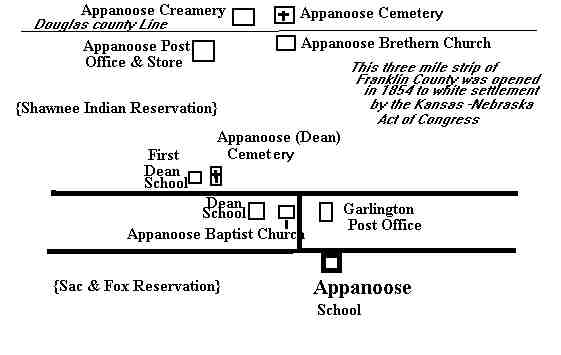
small log shanties. Mr. Daniel Dean, a prosperous land owner and merchant
who was prominent in community affairs, became the first postmaster of
Appanoose Post Office in 1857. He also sold 1 and 1/2 acre of land for
the Dean School which was built of native limestone. The Dean School was
the 75th school in Franklin County therefore it was District #75. At that
time records show there were 3,997 school age children (ages 4 to 20) in
the county, 25 of them lived within the Dean District. I believe the Dean
School was also used for church services for a time. The first burial in
the Appanoose (now called the Dean Cemetery) just east of the building,
was in 1866. These buildings were on land that had once been the Shawnee
Indian Reserve. The Shawnee relinquished their land in 1857, 3 years earlier
than the Sauk and Fox.
More pioneers came and by 1878 the Baptist congregation constructed
the Appanoose Baptist Church, again using native lime-stone, 1/2 mile east
of the Dean School on the south side of the road. The land that had earlier
belonged to the Sauk and Fox. The church stands on the edge of the lush
prairie, probably where Chief Appanoose stood on his arrival here. Later,
Dean Grade School was replaced with a frame building just west of the Appanoose
Church and the original stone school was remodeled into a home. The Garlington
Post Office served that area from 1886-1898.
Roads cut across the prairie, bridges were built across the Appanoose
Creeks and the Appanoose Township was officially organized just 10 years
after Kansas was admitted as the 34th State of the Union. The Township
is in the north west corner of Franklin County. It starts at the Osage
County line and extends east for 5 miles. The north line is the Douglas
County road and then goes south 6 miles.
The population of Appanoose Township was made up of hardy people from
many different countries and cultures, coming here for a multitude of reasons.
Most were farmers but there were various occupations represented. Honesty
and hard work were the way of life. Neighbors helped each other and joined
in barn raising and quilting bees as well as other times of need. Social
activities included barn dances, community picnics and pot lucks, school
programs and church activities.
Education was important to these hard working pioneers. The little one-room
schools offered a good basic education, however, to earn a high school
diploma the students were required to leave the farm, get room and board
in town and pay tuition. This was a financial hardship, making higher education
impossible for many.
As the legislators convened in 1914 at the state capital in Topeka one
of the big concerns was the provision of higher education for the rural
students. Teachers pleaded before the Senate for fair and equal education
privileges. Before congress adjourned in 1915 a law was passed making it
possible for each township or district to build a Rural High School, tuition
free and accessible to every one.
On a frosty April morning in 1918, the sun was bright, meadow larks
were singing and there was excitement and anxiety in the Appanoose community.
Members of the election board, Mr. Bowman, Mr. Montgomery, Mr. Patton,
Mrs. Steele and Miss Kratz were busy setting up the election booths in
the Dean school building. Today would decide whether or not the residents
of Appanoose Township were willing to pass a school bond in the amount
of $12,500.00 for a Rural High School. This was only 6 years after women
had been given voting rights in Kansas. There were 249 eligible voters
registered in Appanoose Township and 187 of them exercised their privileges.
The official count at the end of the day was 138 votes cast in favor of
the new building, 45 against and 4 spoiled ballots. It was a happy time
and plans were now being made for the third high school in Franklin County.
Rantoul and Peoria district had already voted to build high schools. Williamsburg,
Centropolis and Lane voted "no"
on the proposition.
Because there was no city in Appanoose Township it was agreed to place
the new school in the center of the district. The sight of the new school
to be 1/2 mile south and 1/4 mile east of the Appanoose Baptist Church
and Dean School. Unique because it was the only High School at that time
to be built on the prairie away from any town. Mr. B. J. McCoy sold 5 acres
to the district for $75.00 per acre and a well was to be drilled. At last
the pupils of Appanoose Township could receive a high school education
and the community was proud and supportive. Mr. George Washburn of Ottawa,
now famous for designing the Franklin County Court House and many other
historic buildings, was the architect and W. A. Dunn of Lawrence was the
builder. Appanoose High School was organized as Rural High School District
#3. Construction of the building was started but would not be completed
in time for the beginning of school in 1919.
 To
the next section,
To
the next section,