Little is known of the prehistoric Indians who lived here for centuries but written records of the last 300 years tell us that since the late 1700's Illinois had been the home of the Sauk Indians. The Sauk were a farming tribe living together in community lodges made of logs. Some tended the gardens of corn and squash while others gathered berries, roots and nuts, and yet another group hunted and fished. The Medicine Men used wild herbs for their healing potions and clay found near the rivers supplied material for their pottery which was string wrapped and baked. Tools were fashioned from bone and rock. The Sauk lived in peace and harmony with nature.
Unfortunately, by 1830 White Man was crowding the Sauk out of their lands. It was decided to send their most eloquent speaker, Chief Appanoose, to Washington D.C. to represent them in land negotiations. His confidence and knowledge soon won the respect of the politicians. After further talks in Boston he agreed to move his tribe to the land we now call Iowa. (The area they lived in was later named Appanoose County.) White Man continued his quest of the Western Frontier and soon the Indians were forced out of that area also. Chief Appanoose, a peaceful man himself, again represented his tribe in land talks. As a result he led his tribe to a Sauk and Fox reservation in the territory of Kansas, what is now part of Osage and Franklin Counties.
On a spring day in 1840 Chief Appanoose stood observing his new home - Kansas - land of the south winds. Masses of white cumulus clouds drifted in the blue sky while a gentle breeze rippled the prairie grasses. After last night's spring shower the prairie was in full bloom, a vibrance of wild indigo, ground plum vetch, prairie roses, violets and wild hyacinths. On the south slope an abundance of wild strawberries were blooming. The melodious song of the meadowlark broke the silence while a red-tailed hawk circled overhead waiting to dive down on it's next prey. As Chief Appanoose surveyed the endless rolling prairies of his newest home he could look to the west and see cottonwood, sycamore, hickory and oak trees growing along a rushing stream. The bottom land was rich with gooseberries, blackberries and good fishing. To the east was another wooded creek also abundant with wild game and edible plants. Once again community lodges were built, gardens planted and daily life resumed at a normal pace for about 20 years.
On the prairie a "V" formation of geese migrated south. The tall grasses had turned a burnished red-brown and gently swayed in the fall winds. The air was crispy cool and the days noticeably shorter. A family from Missouri, weary from travel in a covered wagon, decided to make camp in this region. In 1856 the timber offered more shelter from the cold winds and would be a better place for the dug-out than the open prairie. After a few days of hard work by every family member the dugout was finished and settled into before temperatures plummeted below zero and a blanket of snow turned the world into a pristine wonderland. As weather permitted logs were cut and squared for the log cabin they would put up in spring.
Finally, after the cold winter, the prairie grasses turned green, blue-eyed iris, yellow star grass, wild onions, violets and prairie parsley bloomed. The red-tailed hawk circled overhead searching for a meal. This was a good place to homestead. More covered wagons brought families from the east and again White Man was taking over the Sauk's home and destroying their livelihood and culture.
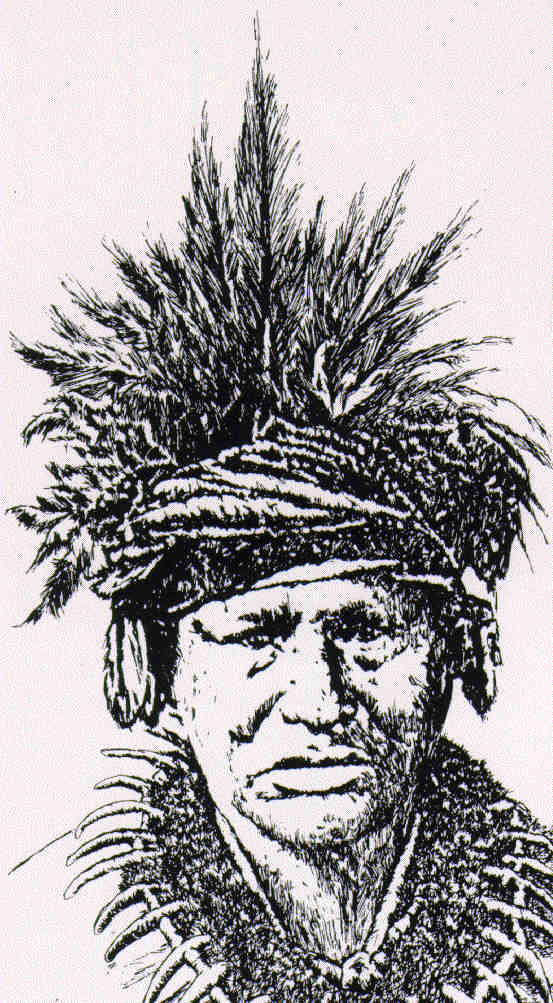
Chief Appanoose |
By 1860 the Sauk and Fox tribe deeded the northern part of their reservation back to the U.S. government and trudged on to Oklahoma Territory. They packed their necessities and left behind their lodges, gardens and a few broken tools that one day would be the site for an archeology dig. Also left, behind was their beloved leader, Chief Appanoose. He is buried in an unmarked grave in the woodlands near the prairie where he first stood on his arrival to this good land.
|
